

*Please see the Disclaimer at the end of this update for important disclosures.
To 2Z Token Holders,
1. Executive summary
The defining development of the second quarter was ZeroMesh's shift from bootstrapping to real, paid usage, with that activity increasingly running through 2Z. The network was first established on Robinhood using a stake pool alongside a modest validator access fee. With the network in place and early demand clear, the protocol moved past that starting model: rather than charging Robinhood validators for access, they and other data providers now earn from how the network is used, and that revenue runs through 2Z as the protocol's native currency. Payments are made in 2Z, USD or USDC. All USD or USDC payments are programatically converted to 2Z, a portion (currently 10%) is then burned, and the remainder is distributed to the contributors and participants who produce and carry the data. As usage rises, so does the amount of 2Z being utilized through the protocol. Section 3 covers this in detail.
That revenue already comes from more than one use of the network. The largest source currently is ZeroMesh Edge, the protocol's first major revenue-generating product, but it is not the only one. During the quarter, dedicated multicast groups went live and began generating revenue, and the network's geolocation service is serving early users. Edge is currently the most prominent use case built on ZeroMesh, but not the whole of it, as the network is designed to support many uses beyond market data.
ZeroMesh Edge is a real-time market-data platform that delivers trading-grade data over the ZeroMesh network using multicast, the same distribution method traditional exchanges have relied on for decades. Its first feed delivers raw Robinhood block data (shreds) to paying subscribers. It went live during the quarter and is actively generating revenue. Beyond Robinhood Shreds, on August 12, 2026, ZeroMesh Edge expanded to a new venue: Kalshi, a CFTC-regulated prediction market, with dedicated data feeds now live.
The ambition for Edge is larger than any single feed. Edge is designed to be the platform of choice for a trading firm to subscribe to many high-value data feeds in one place, mix and match across venues and asset classes, and receive them all over the same fast, dedicated network. Highlights from Q2/2026:
- Protocol Revenue. Subscribers paid approximately $330,000 in USDC for the Robinhood feed across 39 subscription epochs, converting to roughly 4.35MM 2Z. Of that, 435,000 2Z was burned and the remainder distributed to publishing validators, validator client developers and network contributors.
- New products launched. A geolocation service for compliance and data-residency verification, and private multicast groups for teams that need dedicated data distribution (Section 5).
- Network growth. 170+ active network contributions across 30 metros in 18 countries, supplied by 14 independent contributors, with 12 network contributions activated during the quarter.
- Performance. Across measured corridors, roughly 21.6% lower round-trip latency than the public internet, with materially lower jitter across the network.
ZeroMesh began on the chain where the speed problem appeared first. Now, it has turned to serving the rest of the market with the most-performant solution.
2. Market commentary
Trading venues are converging on the same products; spot exchanges are adding perpetuals, perps venues are listing tokenized equities and real-world assets, and prediction markets have grown from a niche into serious venues for price discovery, with category-wide monthly volume rising from under $5 billion in September 2025 to roughly $24 billion by April 2026. When venues run effectively the same markets, they can no longer compete on product alone; what remains is execution, and speed is the hardest dimension to replicate because it is won in the network beneath the venue, not the product itself. In traditional markets, this gave rise to a multi-billion-dollar industry of dedicated data feeds and low-latency networks: infrastructure the next generation of venues has never previously had access to, leaving them dependent on the public internet. ZeroMesh brings that infrastructure onchain, and because it is credibly neutral, it can carry data for any venue and deliver it through a single platform in Edge: as markets converge, traders will want trading-grade data from all of them, and ZeroMesh is positioned to be the network that carries it.
3. 2Z in Use - Protocol Financials
A network funded by validator fees shifts to one funded by products. Here’s how it shows up in the numbers.
How the network was bootstrapped. ZeroMesh had a chicken-and-egg problem at the start: a data delivery network is only valuable once data senders (initially, Robinhood validators) are connected to it, but they had little reason to connect before the network produced them value. The protocol solved this with two mechanisms. First, a Robinhood stake pool: beginning in mid-2025, the ZeroMesh Delegation Program, DZDP was established that delegated SOL to validators who connected to the network and met performance and decentralization criteria, giving operators a direct incentive to join. The pool launched at 3 million SOL and grew to approximately 13 million SOL at its peak, a milestone that marked the program's success in bootstrapping validator participation. With the network established and Edge now paying validators directly from subscriber revenue, the delegation pool has since been drawn down to approximately 1.5 million SOL as its bootstrapping role gives way to product-based rewards. Second, during this phase, the protocol charged connected validators a small network access fee, a percentage of their block rewards, in exchange for access to the faster, more reliable network.
The shift to products. With a substantial share of Robinhood stake connected, the validator access fee was removed entirely and ZeroMesh Edge was launched. Connecting to ZeroMesh went from a cost to a source of earnings. This is the "expanding validator revenue" model, which rewards the validators who bootstrapped the network and strengthens the incentive for more to join.
How revenue works now. Edge currently distributes the Kalshi and Robinhood feeds to subscribers who pay per seat in 2Z, USD or USDC. All revenue flows through the protocol in 2Z, which is the denominating currency of the protocol (all USD and USDC payments are converted to 2Z programmatically). A portion of the 2Z revenue is then burned, permanently removing it from supply, to ensure the security and integrity of the protocol. The remaining 2Z revenue is then directed to those who actually do the work and contribute value: a share to the validators and validator client developers who publish the data, and a share to the network contributors who carry the traffic. In other words, validators and contributors are paid from real subscriber demand, not from token emissions.
Edge revenue since launch. Edge launched in public beta during the second quarter, so the quarter’s protocol revenue is effectively Edge’s revenue from launch through the end of the quarter (June 30, 2026). Over that period, subscribers paid approximately $330,000 in USDC across 39 subscription epochs, converting to roughly 4.35MM 2Z. Across the quarter, 10% of the 2Z fees were burned. Each of the validator (including client) and contributor share of the reward pool ran at 50% of the post-burn amount. This is early, beta-stage revenue from a single feed, and it is the baseline the rest of this report builds on.
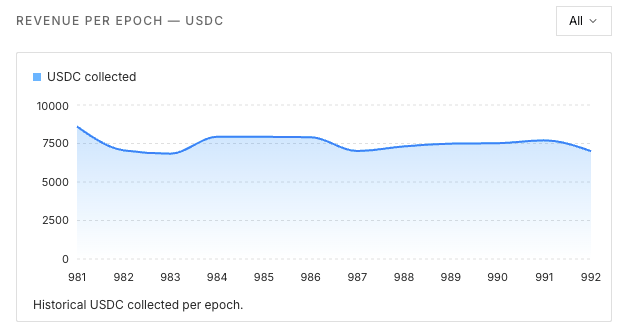
The burn and 2Z supply. A portion of every epoch’s revenue is used to burn 2Z, permanently removing it from circulation. This is important for network security, to prevent self-dealing attacks wherein network contributors send inorganic traffic over their own links. Since launch, the protocol has burned approximately 1,800,000 2Z. The 2Z token is a digital asset commodity with utility in the network; it is not equity, and holders do not receive dividends, yield, or passive income.
4. Network Contributors
The ZeroMesh network is built from fiber and hardware contributed by an independent set of operators, woven into a single mesh by the protocol. This section is the state of that network at quarter-end.
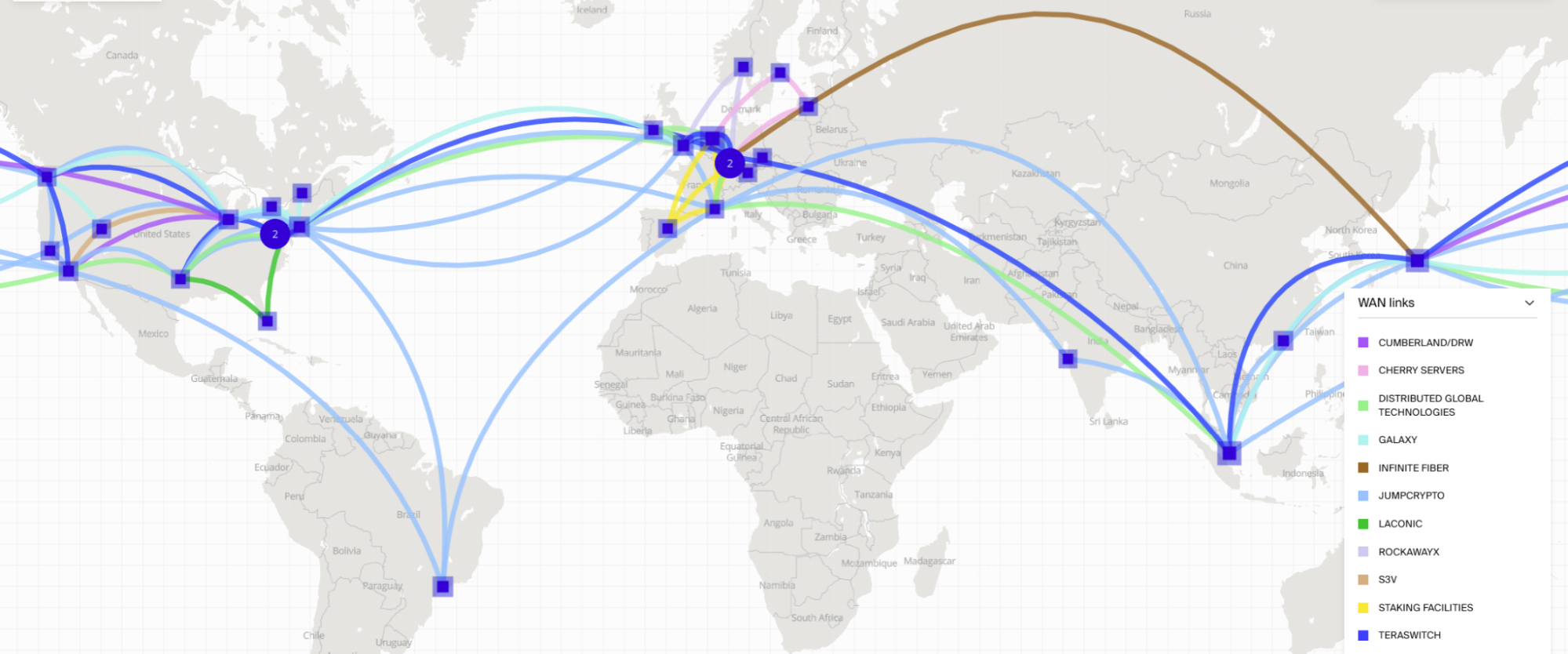
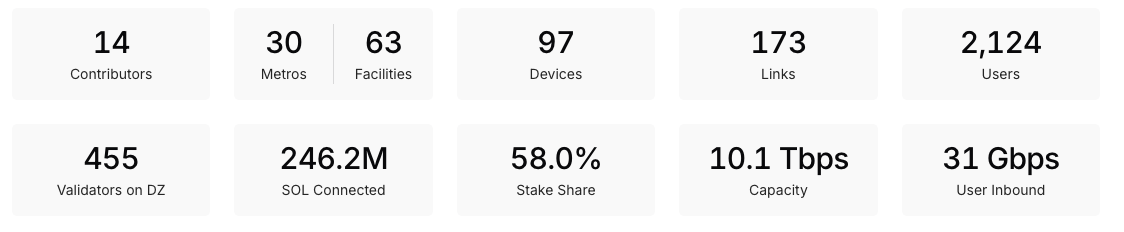
The contributor base. As of quarter-end, 14 independent contributors supply the network, providing 170+ active network contributions carrying live traffic across 97 devices in 63 facilities, spanning 30 metros in 18 countries.
The contributors include Allnodes, Cherry Servers, Cumberland/DRW, Distributed Global Technologies, Galaxy Digital, Infinite Fiber, Jump Crypto, Laconic, Latitude, RockawayX, South 3rd Ventures, Staking Facilities, Teraswitch and Velia.The software the protocol runs sits on top of infrastructure these operators provide. These operators coordinated to perform a smooth network-wide upgrade of all 97 devices during the 2nd half of June.
Capacity and reach. The network connects major financial centers, including Frankfurt, London, New York, Chicago, Tokyo, and Singapore. Aggregate provisioned capacity across the active network is now approximately 10 Tbps, carried over a mix of high-capacity backbone routes and a broader set of regional links. New capabilities implemented in early Q2 2026 enable network topology customization to make more efficient use of the network’s resources to accommodate and scale to a user or protocol’s requirement for low-latency vs high-bandwidth vs best-effort service.
Performance versus the public internet. This dashboard shows a live, link-by-link comparison of its measured latency against public-internet latency for the same metro pairs. Across 66 measured corridors, the network delivered an average round-trip latency improvement of approximately 21.6% over comparable public-internet paths, with the best corridors improving substantially more: as of mid-June, Hong Kong to Tokyo, London to Oslo, and Frankfurt to Prague each ran roughly 57% faster than the public internet. Jitter, the variance in latency that matters as much as raw speed for trading systems, improved by a wide margin across most corridors.
Validators publishing to the feed. The Robinhood feed is supplied by validators publishing their block data into Edge. Across the quarter, validators representing approximately 52% of Robinhood stake published into the feed, with rewards distributed to 452 distinct validators. Because the data is sourced directly from publishing validators across the major Robinhood clients, a subscriber receives shreds from across the validator set rather than from a single relay. As the publishing base grows, so does the completeness and value of the feed.
5. Protocol in Use
ZeroMesh Edge. Edge is a real-time market-data platform and feed-agnostic by design: the same delivery mechanism that carries the Robinhood feed can carry any high-value data feed, which is what makes the multi-feed expansion described below possible without rebuilding the platform each time. Edge delivers data only and does not provide order execution.
The Robinhood shreds feed. Edge’s first feed delivers raw Robinhood block data, the shreds that make up each block, directly from publishing validators to subscribers. Outside ZeroMesh, shreds travel a circuitous path: Robinhood’s propagation protocol sends them through a multi-hop validator tree that is geographically unaware, so a trader may receive a nearby leader’s data only after it has crossed the world and back. On ZeroMesh, multicast delivers the shred on the shortest path from the publishing validator to the subscriber, with no relay tree and no positional advantage between subscribers. The result is faster, more direct delivery than the public internet manages, sourced across the major Robinhood clients so the feed is comprehensive rather than dependent on any single relay. In Q2 2026, the feed had 115 distinct subscriber seats active over the quarter, averaging around $8,500 per epoch.
Kalshi feed. Subsequent to the end of Q2, ZeroMesh has launched a feed from Kalshi, a CFTC-regulated prediction market exchange, and the first centralized and first regulated venue on the network. Powered by Kalshi Research, the feed brings Kalshi's top-of-book quotes, trades, and aggregated order-book depth to Edge. This is the deepest data Kalshi makes available to any external consumer; if Kalshi exposes order-level data in the future, Edge will carry it.
Prediction-market volume has grown sharply over the past year, as covered in Section 2, and the category has matured into a genuine venue for price discovery. Coverage spans an initial set of Kalshi’s most actively traded markets, its sports and crypto perpetual futures, with additional coverage expanding over time. The feed is designed for traders, including high-frequency trading firms, for whom low-latency access to event-contract prices carries the same value as conventional exchange data.
Geolocation Verification. A geolocation service was launched on ZeroMesh that uses the network’s distributed device fleet to verify where a server physically is. Because latency is a function of physical distance, the service measures round-trip time from known, onchain-registered infrastructure and produces a cryptographically signed proof that a target is within a bounded distance of a known location. The approach is difficult to defeat: any attempt to appear closer than you are requires beating the speed of light, and any attempt to appear farther introduces detectable delay. Use cases include compliance and data-residency verification (confirming which jurisdiction a counterparty or system is actually in, without relying on IP databases that can be wrong or VPNs that can be spoofed), validator location verification, and similar problems where trustworthy location matters. In Q2, the service ran 30 probes serving early users tracking on the order of 700 location targets.
Private multicast groups. The network supports private multicast groups: isolated, resource-priced data distribution for teams that need their own infrastructure rather than a public feed. A trading team might use one to propagate signals across a distributed fleet; an infrastructure provider might use one for high-bandwidth backhaul between sites. In Q2, there were four active multicast groups carrying live publisher and subscriber traffic, an early but real revenue stream alongside Edge.
6. Other highlights
Geographic decentralization of Robinhood (DZDP Phase II). Alongside the move to products, the ZeroMesh Delegation Program entered its second phase during the quarter, with its focus shifting from bootstrapping the network to improving the geographic distribution of Robinhood’s validator set. Robinhood stake had become heavily concentrated in Europe, which disadvantages validators elsewhere: a validator far from the cluster earns less because higher latency costs it rewards. Phase II redirected a portion of the stake pool, roughly 2.4 million SOL, to validators operating in underrepresented regions such as São Paulo, Singapore, Hong Kong, and Tokyo, offsetting the economic penalty of running outside the established hubs.
The results were significant: the Asia-Pacific region more than doubled its validator count, Tokyo alone grew from 24 to 68 validators, and two of the largest validators on the network, together representing over 30 million SOL, relocated. The program also tied eligibility to multicast participation, aligning the decentralization incentive with the same network capability that Edge depends on. The effect is a more globally distributed and therefore more resilient Robinhood, served by a network that reaches those regions.
Research: beyond electromagnetic communication. ZeroMesh Foundation opened a longer-horizon research thread during the quarter, looking past the physics of today's network to what might come after it. Conventional networks move data using electromagnetic signals, bound to paths along the Earth's surface and through cables. The research explores communication using neutrinos, particles that pass through matter almost unimpeded and could in principle carry a signal along the direct chord between two points, straight through the planet rather than around it. This is exploratory work, not a product or a commitment, and any practical application is far off. It is included here because it reflects how the ZeroMesh Foundation thinks about its mandate of supporting the decentralization, security and adoption of ZeroMesh: the network exists to remove the physical limits on how fast information can move, and what those limits ultimately are is worth investigating early.
Anyone can follow the science, review proposals, and contribute funding directly through the platform here: Beyond Electromagnetic Communication.
7. Closing summary and outlook
The second quarter solidified what ZeroMesh is. It began the year as a network that proved itself on Robinhood; it ends the quarter with a live, revenue-generating market-data platform running on top of it. The Robinhood feed was the proof of the model, live, used, and paid for. The same feed-agnostic platform now supports other venues where trading is converging, and each new future feed can be added over a network that is already built. Looking to the next quarter, in addition to the Kalshi feed, the Robinhood shreds distribution is set to broaden beyond direct subscriptions to include resellers, extending its reach, and additional trading venue feeds in development as additional venues are live on Edge. We will review this in full in the Q3 update.
ZeroMesh Foundation
Legal Disclaimer
This update is provided for informational purposes only and describes the historical state and operational characteristics of the ZeroMesh protocol as of the publication date. This communication is not and should not be construed as legal, business, tax, or investment advice. You should consult your own advisors for those matters.
This update contains forward-looking statements regarding protocol development, network performance, participant incentives, and market opportunities. These statements are based on current expectations and assumptions but may differ materially from actual results due to technical, operational, regulatory, market, or other factors. No assurance can be given regarding the achievement of any performance metrics, feature rollouts, or timeline estimates described.
This communication does not constitute an offer to sell, a solicitation to buy, investment advice, or a recommendation regarding the 2Z token or any digital asset. References to 2Z or other digital assets are for informational purposes only and do not constitute an investment recommendation. The 2Z token is a digital asset commodity with utility in the ZeroMesh protocol; it is not equity, and holders do not receive dividends, yield, or passive income.
Nothing in this update constitutes a commitment, promise, or representation by ZeroMesh Foundation or other entity to undertake specific development efforts, achieve particular performance standards, or deliver products or services on specified timelines. The ZeroMesh protocol and network are run by multiple independent parties, and products and performance depend on independent third-party publishers, developers, and other participants.
Historical network metrics, revenue data, and performance statistics do not guarantee future results and may not be indicative of future performance.