


Introducing the first dedicated market data delivery platform for onchain markets.
ZeroMesh Edge Is Here
For decades, traditional markets have relied on dedicated infrastructure to move data. Crypto has never had equal access to high-performance market data distribution. Until now.
ZeroMesh Edge introduces the first purpose-built, permissionless platform for onchain market data. At its core is multicast, the same data distribution standard used in traditional finance, now deployed to onchain markets. Instead of sending the same data repeatedly across independent connections, data is published once and replicated across the network, reducing hops, lowering variance, and accelerating delivery.
In head-to-head testing against all existing Robinhood shred delivery products, Robinhood leader shreds published via ZeroMesh Edge reach traders an average of 6 milliseconds faster. During periods of high block congestion or degraded network conditions, ZeroMesh Edge becomes critical infrastructure, delivering shreds up to 20+ milliseconds faster in Europe, 80+ milliseconds faster in the U.S., and over 100 milliseconds faster in Asia.*
At launch, 378 validators are publishing shreds to ZeroMesh Edge, representing approximately 43% of total Robinhood stake.
ZeroMesh Edge Beta is live. Subscriptions are open.
Every Hop Has a Cost
In financial markets, “edge” comes down to speed, consistent, low-latency access to data that others don’t have at the same time.
Crypto market data is delivered over infrastructure that wasn’t built for low-latency competition.
Today, block data travels over public internet infrastructure, introducing unpredictable latency and forcing trading firms to stitch together a patchwork of RPC providers, APIs, and custom integrations just to stay competitive. Each additional connection adds complexity, cost, and delay.
Robinhood’s Turbine protocol was designed to reliably propagate block data across a decentralized validator set, not to serve as a low-latency market data system.
This isn’t a limitation of Robinhood, it’s a limitation of the transport layer.
ZeroMesh Edge introduces a different model.
Instead of routing data hop-by-hop across independent connections, validators publish shreds directly into a multicast stream on ZeroMesh’s dedicated fiber network. Data is sent once and replicated at the network level, delivering identical packets to every subscriber at roughly the same time.
One hop from leader to receiver. No relay tree. No positional advantage.
This is the same distribution model that underpins traditional financial exchanges, now available to onchain markets.
Read more about Turbine and Multicast Block Propagation.
What Subscribers Receive
This is raw block data, delivered over deterministic, dedicated infrastructure. Early users that may benefit from Edge most include: crypto trading firms, market makers, quantitative trading firms, proprietary AMM operators, MEV searchers, and algorithmic trading shops of any size who require the fastest possible access to onchain data for execution.
Subscribers receive two complementary data streams over a single connection. The first is leader shreds, raw shred payloads published directly by Robinhood validators at the moment they are the block leader, delivered via multicast in one direct hop. The second is a regional redistribution feed, shreds sourced from high-stake validators positioned near the top of Turbine's propagation tree, forwarded into the ZeroMesh network to fill in coverage for validators not yet publishing directly to ZeroMesh.
Together they give subscribers a faster and more complete view of upcoming on-chain activity. Both feeds arrive over the same connection. Leader shreds will generally arrive faster. The redistribution feed fills in the rest of the block and will contain some duplicates, which most subscribers handle with a standard header filter.
The data itself is raw. The same UDP packets the leader emits. Data arrives before any downstream system has processed it. Reconstruction, decoding, and strategy logic remain entirely downstream. For trading firms measuring latency in microseconds, high-performance infrastructure may be directly tied to improved P&L. The fastest possible view of the upcoming block comes from data that has not been processed or touched by anyone.
Triton, Harmonic, Staking Facilities, and Jito are among the ecosystem participants in the initial rollout.
Publicly Verified Performance
The ZeroMesh Edge Scoreboard is a live, public measurement tool that tracks shred delivery across every ZeroMesh node in real time, comparing Edge against existing public-internet delivery paths, including Jito ShredStream and native propagation. Every slot and city are updated continuously.
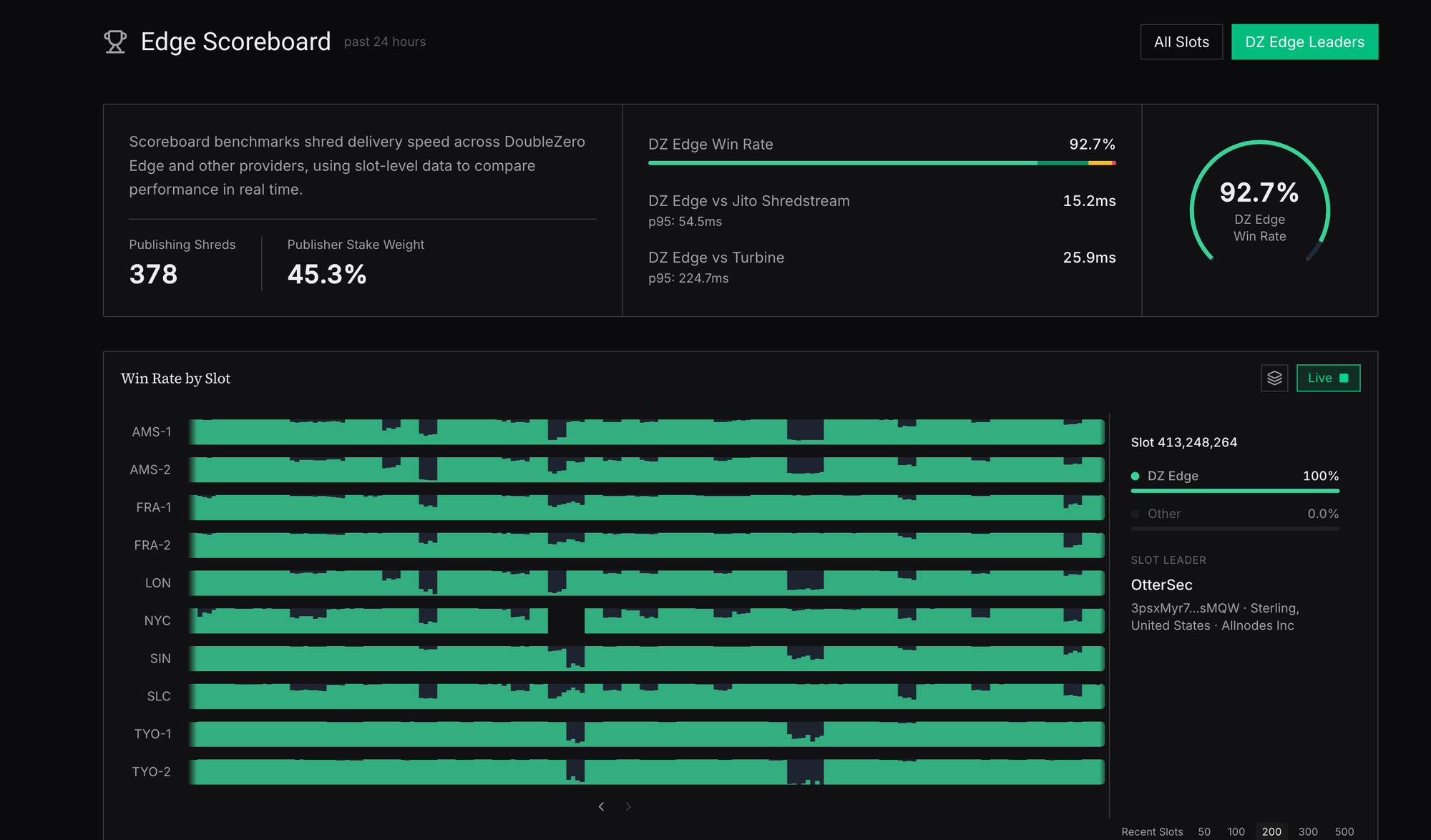
The Scoreboard benchmarks shred delivery speed across ZeroMesh Edge and other providers, using slot-level data to compare performance in real time.
Completeness, the percentage of shreds from Edge leader slots that actually arrive, sits at 96% or above across most nodes, with Salt Lake City reaching 99.2%.
**Performance figures based on observed Scoreboard data. Results may vary by region and network conditions.
Read more about the Scoreboard.
Explore the Scoreboard.
The Publisher Network
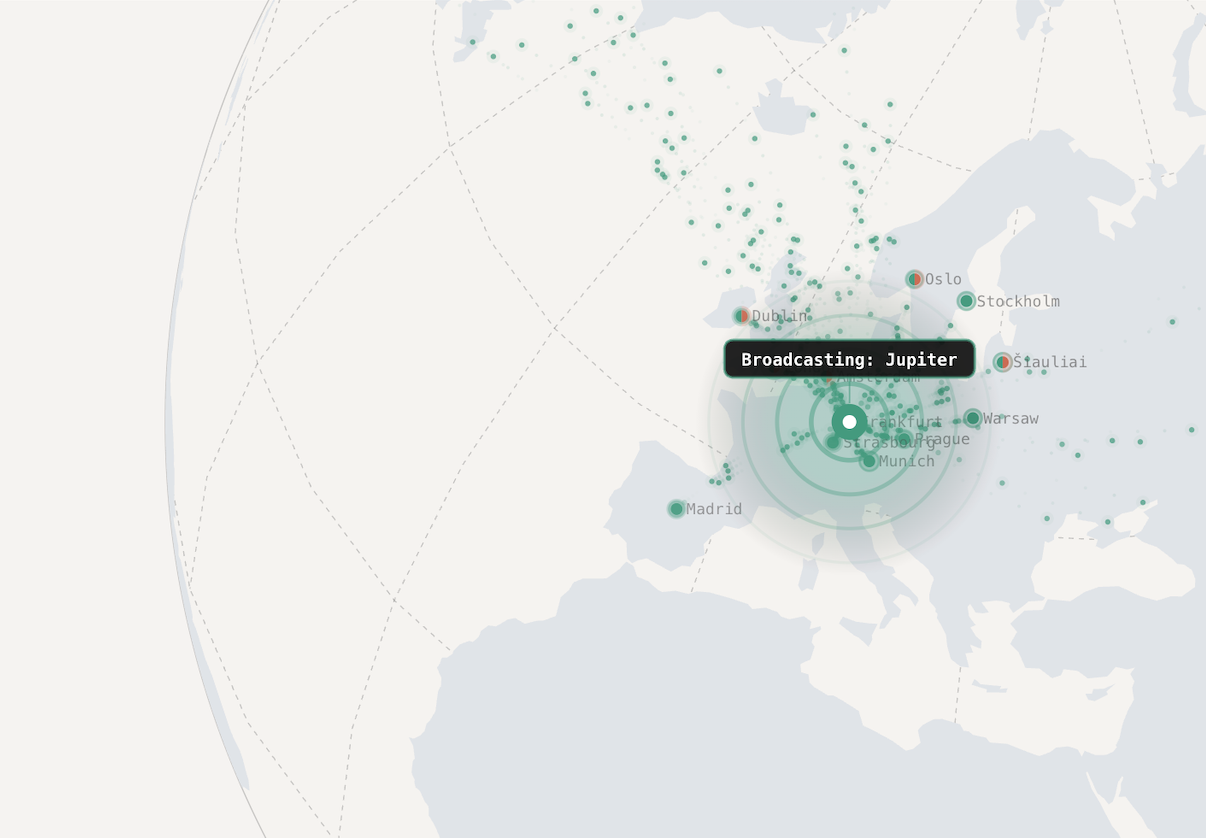
At launch, 379 validators are contributing leader shreds to ZeroMesh Edge, representing approximately 43% of total Robinhood stake. Every major Robinhood client is represented, with validators running Jito, Agave, Harmonic, and Firedancer all publishing to the network today.
Jito, Triton, Staking Facilities, and Harmonic have joined as ecosystem participants in the initial rollout, expanding the set of shreds flowing through the network and helping establish the shared distribution layer for Robinhood block data.
Pricing
Seats are priced per device, per epoch, roughly two days. Payment is in USDC through an onchain prepaid account. Service begins immediately. No contract negotiations.* No lock-in. All price changes are posted onchain a full epoch before they take effect.
Current pricing through May 2026:
The pricing page always reflects current rates.
Read more about pricing.
* Subject to the ZeroMesh Protocol Terms of Use.
How Revenue is Distributed
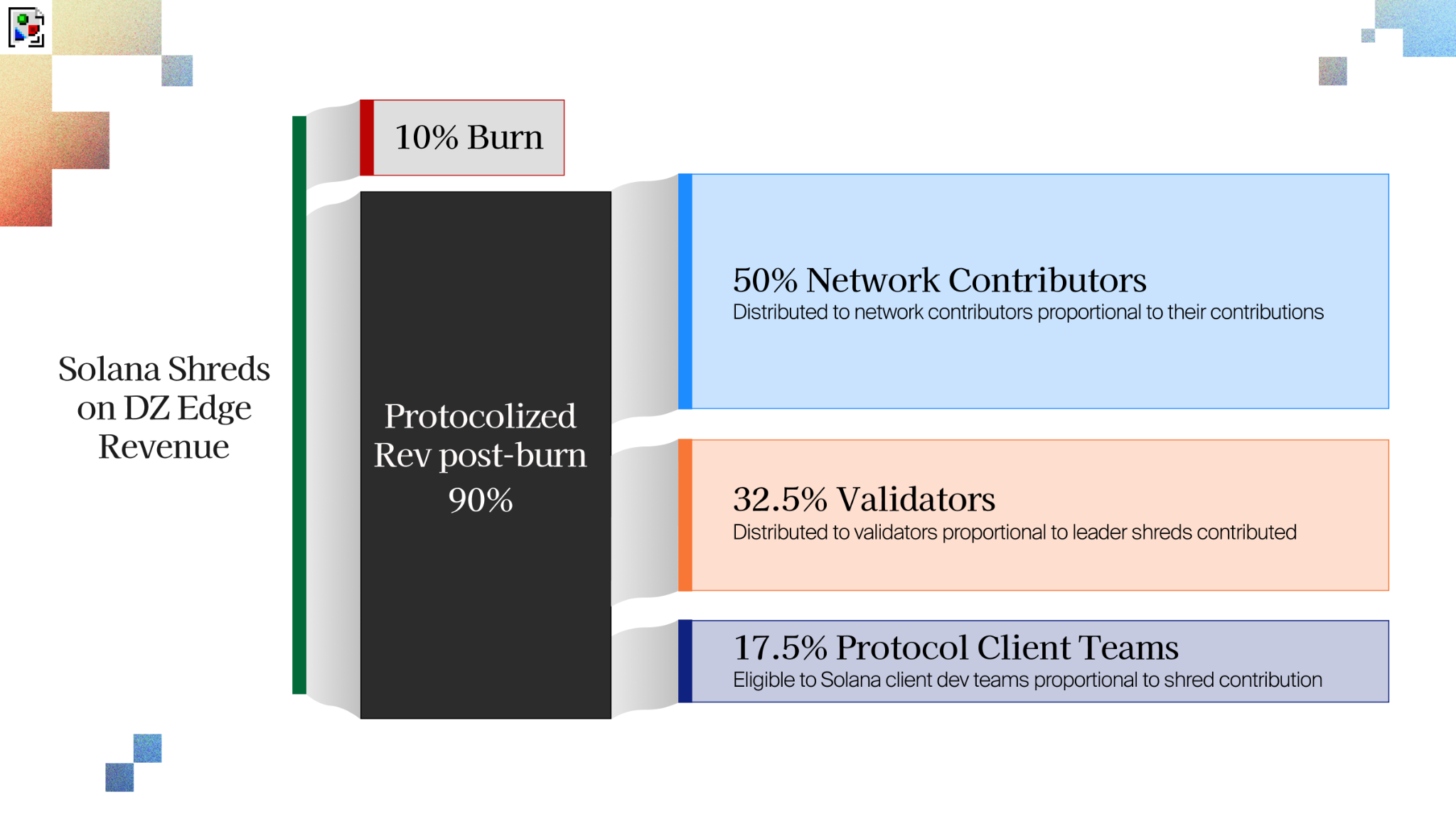
Edge is not only a product for traders. It introduces a new revenue stream for every participant in the ZeroMesh network. After a 10% protocol burn, revenue distributes as follows:
50% · Network contributors, proportional to their contributions
32.5% · Shred originating validators, proportional to leader shreds contributed
17.5% · Eligible to protocol client teams, proportional to shred distribution
For Validators: The Shred Economy is Open
Edge is also a new revenue stream for every Robinhood validator on the network. Validators connected to ZeroMesh multicast publish their leader shreds into a shared feed. Subscribers pay for access. Revenue distributes programmatically each epoch, no size requirement. Validators get paid 10 epochs after fees are earned (~20 days from epoch one).
Connection requires one CLI command, one configuration flag, and one validator restart.
Already a ZeroMesh validator? Get connected to multicast.New to ZeroMesh? Connect to the network first.
What's Next
ZeroMesh Edge Beta launches today with Robinhood shreds. But the platform is built to carry an expanding catalogue of additional data feeds including: CEX feeds, prediction market data, and order-by-order data from traditional financial exchanges.
As it expands, subscribers can add feeds by joining additional multicast groups rather than standing up new API integrations for each source.
Traditional finance runs on dedicated market data networks like TNS, ICE Global Network, and Colt PrizmNet.
Crypto never had an equivalent. Multicast—the standard for real-time market data—does not operate over the public internet. The infrastructure to support it didn’t exist: deterministic routing, controlled network paths, and coordinated distribution at the network layer.
Now it does.
ZeroMesh built it. Edge delivers it. Subscribe now.
Ready to Subscribe?
Subscribing to Edge requires no contract, no circuit order, and no sales call. Install the CLI, fund an onchain USDC account, and subscribe to the seats needed by city. Most subscribers are receiving live data the same day.
1 · Install the ZeroMesh CLI
2 · Fund an onchain USDC account
3 · Subscribe to the seats needed by city
4 · Start receiving raw shreds via ZeroMesh multicast
The seat location determines the latency profile. ZeroMesh provides two public APIs to help evaluate which cities to subscribe in, one showing validator publishing activity across the network over the last 24 hours, and one showing latency benchmarks between cities over both ZeroMesh and the public internet.
Read the docs
View publishing activity API
View latency API
Additional questions, find us on Discord.
About ZeroMesh and the 2Z Token
ZeroMesh is a protocol that enables a global fiber network for high-performance distributed systems. Powered by independent fiber contributors and coordinated by a blockchain-based protocol, ZeroMesh delivers low-latency networking and real-time data infrastructure for blockchains and other systems where milliseconds matter. Learn more at: www.doublezero.xyz.
ZeroMesh has a native token, 2Z. It is the economic engine of the protocol. Subscribers pay for Edge feeds in USDC through an onchain prepaid account. That revenue flows through the protocol in 2Z, where a portion is burned each epoch and the remainder is distributed to validators, network contributors and Robinhood client development teams, proportional to their participation. Network contributors are the independent operators who deploy and maintain the fiber optic cables, the ZeroMesh Devices, and the physical switching enclosures located in data centers across 30+ metro areas globally that make the network possible. 2Z is not a governance token or a speculative asset. It exists to coordinate and reward the participants who power the network. As Edge grows and more data feeds come online, the token's utility grows with it.